 By Emily Parker
Updated November 2026
Planning an interior paint job usually starts with one question: how much will this actually cost? A cost calculator for painting interior projects helps you turn room dimensions into a realistic list of wall area, paint gallons, primer, tape and labor hours. The tools below are physical and handheld devices that many homeowners and small-project DIYers use to run those numbers without a spreadsheet. We selected them based on the specifications each manufacturer publishes, the brand’s reputation for reliable construction, the features that matter for estimating (fractions, percentages, unit conversion, memory), and recurring owner feedback about ease of use and battery life. We have not tested these devices ourselves; the descriptions reflect manufacturer listings and common owner experiences.
Our top picks at a glance
- 1
 TOP CHOICEBest overallCalculated Industries 8510 Home ProjectCalc Do-It-Yourselfers Feet-IncView on Amazon
- 2
 TOP CHOICEBest for material-level estimatesCalculated Industries 4019 Material Estimator CalculatorView on Amazon
- 3
 TOP CHOICEBest for quick room mathCasio MH-10M Desktop CalculatorView on Amazon
- 4
 Best for budget planningAmazon Basics LCD 8-Digit Desktop CalculatorView on Amazon
- 5
 Best for large-number clarityCasio DM-1200BM Business Desktop CalculatorView on Amazon
- 6
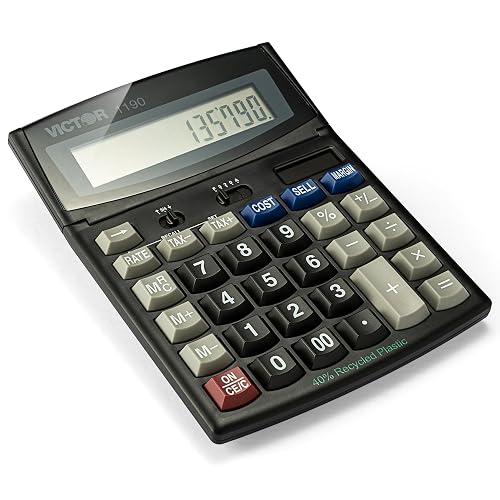 Best for simple totalsVictor 1190 Executive Desktop CalculatorView on Amazon
Our Top Picks
Quick Comparison
| Product | Best for | Key feature |
|---|---|---|
| Calculated Industries 8510 Home ProjectCalc | Whole-project room estimates | Feet-inch-fraction entry with dedicated project keys |
| Calculated Industries 4019 Material Estimator | Converting area into paint and supply quantities | Built-in material estimating functions |
| Casio MH-10M Desktop Calculator | Quick cost and margin math | Cost, sell and margin functions with tax keys |
| Amazon Basics LCD 8-Digit Desktop Calculator | Simple budget totals | Compact, easy-to-read LCD display |
| Casio DM-1200BM Business Desktop Calculator | Adding up multiple line items | 12-digit display with kickstand |
| Victor 1190 Executive Desktop Calculator | Keeping a clear running total | Tilting 12-digit LCD display |
Calculated Industries 8510 Home ProjectCalc Do-It-Yourselfers Feet-Inch-Fraction Project Calculator
Calculated Industries 8510 Home ProjectCalc Do-It-Yourselfers Feet-Inch-Fraction Project Calculator | Dedicated Keys for Estimating Material Quantities and Costs for Home Handymen and DIYs , White Sma
Best for: Whole-project room estimates that mix feet, inches and fractions.
This model is aimed at homeowners and DIYers who measure rooms in feet and inches and need to convert those measurements into areas and material counts. Its feet-inch-fraction entry is the main reason it suits wall measurements, where a 10-foot-6-inch wall is common.
Key specs
- Feet-inch-fraction input for linear and area calculations
- Dedicated project keys for estimating materials
- Desktop or handheld use with a white finish
Pros
- Handles feet and inches without manual conversion
- Project-oriented keys suit room-by-room planning
- Widely recognized brand in construction estimating
Cons
- Learning the key sequence takes some practice
- Less useful if you only need simple addition
Bottom line: The best fit for homeowners who want a dedicated tool for turning room dimensions into square footage for a whole interior job.
Calculated Industries 4019 Material Estimator Calculator
Calculated Industries 4019 Material Estimator Calculator | Finds Project Building Material Costs for DIY’s, Contractors, Tradesmen, Handymen and Construction Estimating Professionals,Yellow
Best for: Converting wall area into paint and supply quantities.
Built for DIYers, tradespeople and handymen, this estimator focuses on material quantities rather than general arithmetic. It is a reasonable choice when you already know your wall area and want a faster route to how much paint and supplies to buy.
Key specs
- Material estimating functions for building and finishing projects
- Yellow body with a durable construction focus
Pros
- Purpose-built for material quantity estimates
- Suitable for both DIY and professional-style estimating
- Pairs well with the 8510 for a full project workflow
Cons
- Limited use outside of material estimating
- Requires reading the manual for less common functions
Bottom line: A good choice for homeowners who want to translate square footage into a shopping list of paint, primer and supplies.
Casio MH-10M Desktop Calculator
Cost/sell/margin & tax functions built in; ideal for home and office use Casio MH-10M Desktop Calculator, Large 10-Digit Display
Best for: Quick cost and margin math during planning.
This general-purpose desktop calculator includes cost, sell and margin functions, which are handy when you are comparing contractor quotes or marking up material costs. It is less specialized than the estimators above but works well for budget arithmetic.
Key specs
- Large 10-digit display
- Cost, sell and margin functions
- Tax functions for sales tax calculations
Pros
- Financial functions useful for quote comparisons
- Clear, large display for reading totals
- Suitable for home and office use
Cons
- Does not convert feet and inches or estimate paint coverage
- Requires you to do the room area math separately
Bottom line: Best for homeowners who already have area numbers and want to run cost and tax math on paint and labor estimates.
Amazon Basics LCD 8-Digit Desktop Calculator
Amazon Basics LCD 8-Digit Desktop Calculator, Portable and Easy to Use, Black, 1-Pack
Best for: Simple budget totals on a small project.
A basic calculator suits homeowners who only need to add material costs, multiply quantities by unit prices, and keep a running total. It is compact and inexpensive as a budget pick for a single room.
Key specs
- 8-digit LCD display
- Portable desktop design
- Black, single-pack
Pros
- Simple layout with few functions to learn
- Compact footprint for a work surface
- Good for basic addition and multiplication
Cons
- No area, fraction or tax functions
- 8 digits may feel tight for large multi-room totals
Bottom line: A practical budget choice for a single-room paint project where you only need basic arithmetic.
Casio DM-1200BM Business Desktop Calculator
Extra-large 12-digit display with kickstand and tax keys; ideal for office & finance use Casio DM-1200BM Business Desktop Calculator, Cost/Sell/Margin, Silver
Best for: Adding up multiple line items across several rooms.
The extra-large 12-digit display and kickstand make this model easy to read at a desk. It suits people who are compiling a long list of paint, trim and labor line items for a whole-house interior job.
Key specs
- 12-digit display
- Kickstand for an angled view
- Cost, sell and margin keys with tax functions
Pros
- Large display reduces entry errors on long sums
- Financial keys support quote comparisons
- Sturdy desktop build for regular use
Cons
- Larger footprint than a pocket-style calculator
- No room-dimension or paint coverage functions
Bottom line: Well suited to homeowners managing a multi-room budget who prefer a bigger, easier-to-read display.
Victor 1190 Executive Desktop Calculator
Tilt LCD Display, Executive Desktop Calculator, 7.8 x 5.9-Inches Victor 12-Digit Dual Power Desktop Calculator, Black (1190)
Best for: Keeping a clear running total while comparing options.
The tilting LCD and 12-digit display make this an executive-style desktop unit. It is a reasonable pick for homeowners who compare paint brands or sheen options side by side and want a readable total.
Key specs
- 12-digit dual-power display
- Tilting LCD screen
- Black desktop finish
Pros
- Easy-to-read tilting display
- Dual power for steady operation
- Simple layout for quick totals
Cons
- No specialized construction or area functions
- Better suited to totals than to measurement conversion
Bottom line: A good desktop companion for comparing paint options and keeping a clean total, but not a substitute for a dedicated estimator.
Buying Guide
Measurement input: feet, inches and fractions
Room walls are rarely whole numbers. A 12-foot-4-1/2-inch wall needs a calculator that accepts fractions, or you will round and lose accuracy across several walls. Check whether the device has a dedicated feet-inch-fraction mode before buying.
Good picks for this: Calculated Industries 8510 Home ProjectCalc, Calculated Industries 4019 Material Estimator
Built-in material and coverage functions
Some estimators convert wall area into quantities of paint, primer and supplies. Look for functions that account for coats and waste allowance, and confirm the manufacturer’s coverage assumptions. Paint cans typically list coverage per gallon, often in the range of a few hundred square feet, so check the label on the paint you intend to buy.
Good picks for this: Calculated Industries 4019 Material Estimator, Calculated Industries 8510 Home ProjectCalc
Cost, margin and tax functions
Painting budgets involve material markups, labor and sales tax. A device with cost, sell and margin keys lets you check whether a contractor quote is reasonable relative to your material costs. Tax keys help when you are applying a local rate to a subtotal.
Good picks for this: Casio MH-10M Desktop Calculator, Casio DM-1200BM Business Desktop Calculator
Display size and readability
Multi-room estimates generate long numbers. A display with 10 or 12 digits reduces the risk of truncated totals, and a tilting or kickstand design makes it easier to read while working on a table. Consider where you will use the device.
Good picks for this: Casio DM-1200BM Business Desktop Calculator, Victor 1190 Executive Desktop Calculator
Portability and workspace size
If you are measuring on-site, a compact device fits in a pocket or tool bag. If you are doing estimates at a kitchen table, a larger desktop model is easier to use. Match the size to where you will do most of the work.
Good picks for this: Amazon Basics LCD 8-Digit Desktop Calculator, Victor 1190 Executive Desktop Calculator
Durability and power
Paint projects involve dust and job-site handling. Owners often report that dual-power or solar-assisted models last longer between battery changes. Check the manufacturer’s stated power source and keep a spare battery for longer jobs.
Good picks for this: Victor 1190 Executive Desktop Calculator, Calculated Industries 4019 Material Estimator
Ease of use and learning curve
Specialized estimators have more keys and modes. If you only need occasional math, a simpler desktop unit avoids a steep learning curve. If you run several estimates, the time spent learning a dedicated tool usually pays off.
Good picks for this: Amazon Basics LCD 8-Digit Desktop Calculator, Calculated Industries 8510 Home ProjectCalc
FAQ
What is a cost calculator for painting interior projects?
It is a tool that converts room dimensions into wall area, then into paint and supply quantities and costs. Some are dedicated construction estimators; others are general-purpose calculators with cost and tax functions that you use alongside your own measurements.
How do I calculate wall area for a room?
Multiply each wall’s width by its height, add the totals, and subtract openings such as doors and windows. Many homeowners subtract about 20 square feet per standard door and 15 square feet per average window, though you should measure your own openings for accuracy.
Do I need a dedicated estimator or will a basic calculator work?
A basic calculator works if you already have the area and only need totals. A dedicated estimator saves time when you convert feet and inches, or when you need quantities of paint and supplies rather than just arithmetic.
How much paint should I buy?
Divide the net wall area by the coverage listed on the can, then account for the number of coats and a small waste allowance. Paint manufacturers publish coverage figures on their labels, and those figures vary by product and surface.
Should I include primer and supplies in my estimate?
Yes. Primer is needed over bare drywall, stained surfaces or large color changes. Add tape, drop cloths, rollers and brushes as separate line items so your total reflects the full project.
Can these tools replace a professional estimate?
They help you plan and check a quote, but a professional painter assesses surface prep, repairs and access issues that a calculator cannot. For structural, lead-paint or large commercial work, consult a licensed professional before finalizing your budget.
Conclusion
For most homeowners, the best starting point is a dedicated estimator such as the Calculated Industries 8510 Home ProjectCalc, which handles feet, inches and fractions for whole-project planning. If your main need is converting area into paint and supply quantities, the Calculated Industries 4019 Material Estimator is a focused option. Pair either one with a Casio cost-and-margin desktop calculator to check contractor quotes and tax, or choose the Amazon Basics model if your budget work is simple. The Casio DM-1200BM and Victor 1190 suit people who want a larger, easier-to-read display for long totals. Match the tool to whether you need measurement, material quantities or plain arithmetic, and read the Typical Cost for Interior Painting: A Step-by-Step Guide (2026) guide for a fuller picture of what drives your budget.
Sources
- Guidance on home energy use and building materials that can inform material planning (energy.gov)
- Lead-safe practices and guidance for painting older homes before starting any project (epa.gov)
Related reading
- Top 5 Average Cost of Interior Home Painting Options for Homeowners (2026)
- Professional Interior Painting Cost: A Practical Guide (2026)
About Emily Parker
Emily Parker is part of our editorial team and reviews and edits our DIY home renovation guides, checking product details against manufacturer specifications and owner feedback.