Quick answer
Our overall pick for the best caulking gun is the BatesChoice CG01 for its versatile material compatibility and strong 10:1 thrust ratio. The Cocew kit is best for those wanting a complete set with finishing tools, while the ValueMax and Newborn models are strong options for users prioritizing a no-drip design or a professional-grade high thrust ratio, respectively.
Applying caulk or sealant is a fundamental skill for many home repairs and renovations, from sealing a kitchen backsplash to weatherproofing a window. The right caulking gun makes the job cleaner, easier, and less tiring. To find the best caulking gun for different needs, we compared manufacturer listings and specifications for several widely available models.
We looked at key factors like thrust ratio for smooth dispensing, build features like revolving barrels for corners, and whether useful tools like spout cutters were included. Here are our picks based on that specification comparison.
Our picks at a glance

Pros
- 10:1 thrust ratio for controlled dispensing
- Compatible with a wide range of sealants and adhesives
- Ergonomic design for comfortable use
- Listed as a no-drip sealant gun
Cons
- The listing does not mention an included spout cutter or puncture tool
- Hand-powered operation requires user effort

Pros
- Comes with a caulk remover and finishing scraper tool
- Includes a spout cutter and unclogging needle
- Features a 360-degree revolving barrel
- Drip-free trigger mechanism
Cons
- The listing's 'Power Source: Dc' is unclear for a manual tool
- The listed compatible material is only 'Glass', which seems limited for a caulk gun

Pros
- Specifically designed as a no-drip caulking gun
- Includes a built-in spout cutter and seal puncture pin
- 360-degree rotatable barrel for flexibility
- Rubber-covered trigger for comfort
Cons
- The listing specifies a cure time, which is a property of the sealant, not the gun
- Requires manual lubrication after use, according to the note
Pros
- High 18:1 thrust ratio for thick materials
- Smooth pressure rod reduces effort and noise
- Durable zinc alloy construction with rubber grip
- Includes spout cutter and seal puncture tool
Cons
- Heavier build may not be necessary for light tasks
- The listing states it is 'Not Water Resistant', a spec likely meant for sealants
How we chose
Our editors compared the manufacturer listings and specifications for these caulking guns on Amazon as of October 2026. We did not conduct hands-on testing. Our comparisons focused on the thrust ratio for dispensing control, included features like spout cutters and puncture tools, material compatibility, and the overall design for ease of use.
Best Caulking Guns: our picks in detail
1. Best overall: BatesChoice CG01 Caulking Gun
The BatesChoice CG01 is our overall pick for its balance of power and versatility. It features a 10:1 thrust ratio for what the listing describes as precise bead control and consistent flow. The listing states it is designed to dispense various materials including acrylic, adhesives, asphalt, butyl, and cement.
Its ergonomic design is noted for a comfortable grip to help reduce hand fatigue during long jobs. The listing highlights it as a silicone application tool for home repair and sealing work in bathrooms and kitchens.
Best for: This is the best caulking gun for general-purpose sealing with a variety of materials.
Pros
- 10:1 thrust ratio for controlled dispensing
- Compatible with a wide range of sealants and adhesives
- Ergonomic design for comfortable use
- Listed as a no-drip sealant gun
Cons
- The listing does not mention an included spout cutter or puncture tool
- Hand-powered operation requires user effort
2. Best kit with tools: Cocew Caulking Gun Kit
The Cocew kit is a complete set that includes a caulking gun alongside a caulk remover and finishing tool. The gun itself has a smooth pressure rod and a 360-degree revolving barrel to help maintain bead orientation around corners. The listing mentions drip-free technology that prevents dripping by releasing the trigger.
It comes with a through-needle for unclogging and a spout cutter to open tubes. The kit is presented in a gift box and is intended for use in various scenarios like kitchens, bathrooms, walls, and windows.
Best for: This is the best caulking gun for DIYers who want a full kit with removal and finishing tools.
Pros
- Comes with a caulk remover and finishing scraper tool
- Includes a spout cutter and unclogging needle
- Features a 360-degree revolving barrel
- Drip-free trigger mechanism
Cons
- The listing’s ‘Power Source: Dc’ is unclear for a manual tool
- The listed compatible material is only ‘Glass’, which seems limited for a caulk gun
3. Best for no-drip control: ValueMax No Drip Caulking Gun
The ValueMax caulking gun emphasizes a no-drip design and user comfort. It features an 8:1 thrust ratio, a 360-degree rotatable barrel, and a built-in spout cutter. The listing notes a rubber-covered trigger for a soft grip and a seal puncture pin to open tubes.
It is designed to hold standard 10-ounce cartridges and is applicable for gaps and joints around windowsills, sinks, and toilet bases. The metal handle can act as a hook for hanging on a ladder.
Best for: This is the best caulking gun for users who prioritize drip prevention and convenient built-in tools.
Pros
- Specifically designed as a no-drip caulking gun
- Includes a built-in spout cutter and seal puncture pin
- 360-degree rotatable barrel for flexibility
- Rubber-covered trigger for comfort
Cons
- The listing specifies a cure time, which is a property of the sealant, not the gun
- Requires manual lubrication after use, according to the note
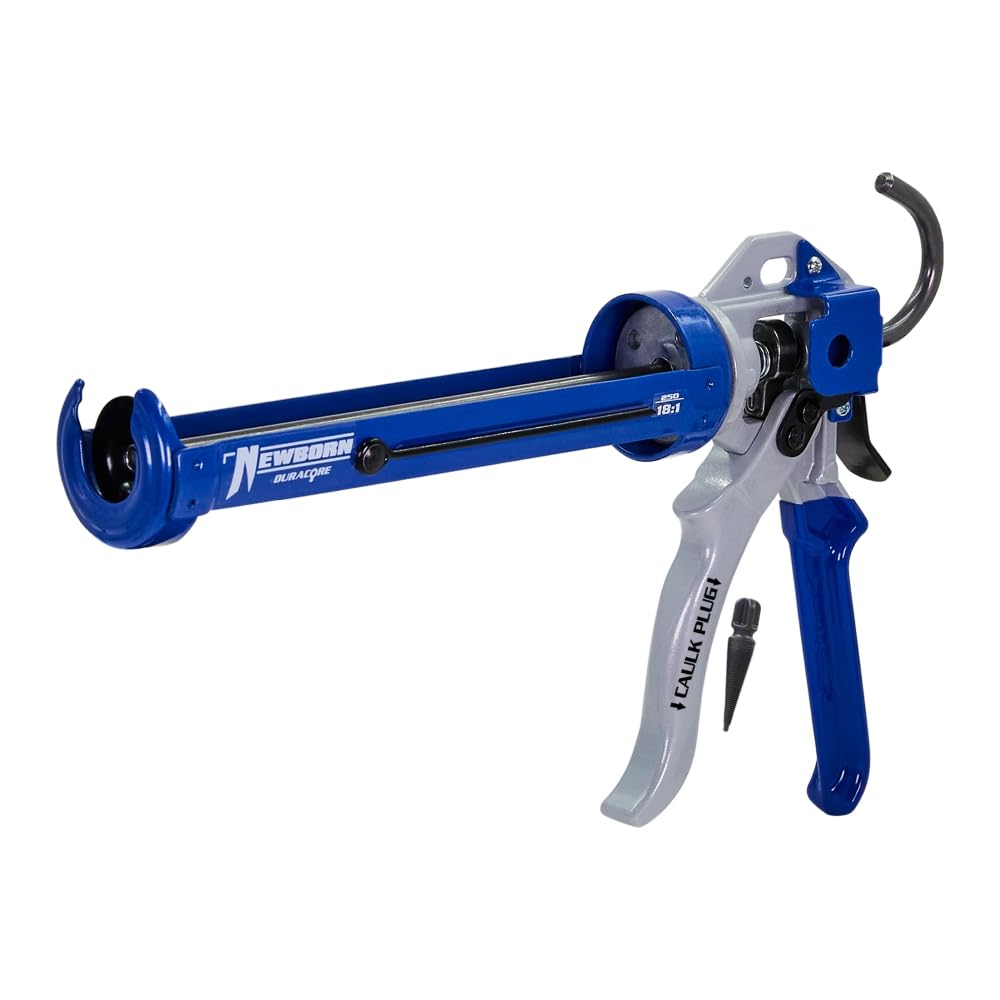
4. Best high-thrust professional: Newborn 250 Super Smooth Rod
The Newborn 250 is built for demanding professional use with a high 18:1 thrust ratio. This is designed to handle thick materials like silicone, polyurethanes, and epoxies with precise control. It features a smooth pressure rod for quieter, less effortful operation and a revolving steel frame for easy bead orientation.
The handle and trigger are made from durable zinc alloy with a rubber grip. It includes a spout cutter and seal puncture tool and has a 1/10-gallon cartridge capacity.
Best for: This is the best caulking gun for professionals or serious DIYers working with thick, demanding sealants.
Pros
- High 18:1 thrust ratio for thick materials
- Smooth pressure rod reduces effort and noise
- Durable zinc alloy construction with rubber grip
- Includes spout cutter and seal puncture tool
Cons
- Heavier build may not be necessary for light tasks
- The listing states it is ‘Not Water Resistant’, a spec likely meant for sealants
Caulking gun picks at a glance
| Model | Thrust Ratio | Key Features | Included Tools |
|---|---|---|---|
| BatesChoice CG01 | 10:1 | No-drip, ergonomic grip | Not listed |
| Cocew Kit | Not listed | 360° barrel, drip-free trigger | Spout cutter, needle, remover tool |
| ValueMax | 8:1 | No-drip, 360° barrel, comfort grip | Built-in spout cutter, puncture pin |
| Newborn 250 | 18:1 | Smooth rod, revolving steel frame | Spout cutter, puncture tool |
How to choose a caulking gun
The best caulking gun for your project depends on the type of sealant you’re using and the control you need. A higher thrust ratio, like 10:1 or 18:1, provides more mechanical advantage, making it easier to dispense thicker materials like polyurethane or certain adhesives smoothly and with less hand fatigue. For standard acrylic or silicone caulk in cartridges, a mid-range ratio is often sufficient.
Look for features that improve usability. A rotating barrel lets you rotate the cartridge to maintain the perfect bead angle around corners or tricky joints. A no-drip or dripless mechanism stops the flow when you release the trigger, preventing messes. Built-in tools like a spout cutter to open the tube and a puncture pin to break the inner seal are convenient additions that mean you don’t have to hunt for separate tools.
What to look for
- Thrust Ratio: Higher ratios (e.g., 10:1, 18:1) provide more power for thicker sealants.
- Drip Control: A no-drip mechanism prevents sealant from oozing after you stop squeezing.
- Revolving Barrel: Allows you to rotate the cartridge for better control on angled surfaces.
- Included Tools: Spout cutters and seal puncturers add convenience to your project setup.
Consider the grip and weight if you have a large area to cover. A comfortable, rubber-coated handle can make a long caulking session much easier. For more on basic home repair tools and techniques, visit our guide on repair basics.
FAQ
What does ‘thrust ratio’ mean on a caulking gun?
The thrust ratio is the mechanical advantage of the gun. A 10:1 ratio means that for every 10 pounds of force you apply on the trigger, the plunger exerts 1 pound of force on the tube. A higher ratio makes it easier to dispense thicker, more viscous sealants with less hand effort.
Do I need a caulking gun with a revolving barrel?
A revolving barrel is very helpful but not strictly necessary. It allows you to rotate the cartridge so the nozzle is always at the optimal angle to the surface you’re sealing, which is especially useful when working on inside or outside corners, or on vertical surfaces.
What’s the difference between a dripless and a standard caulking gun?
A dripless (or no-drip) caulking gun has a mechanism that creates a slight vacuum or releases pressure when you let go of the trigger. This stops the sealant from continuing to flow out of the nozzle, which helps create a cleaner bead and reduces waste and mess.
Can one caulking gun work with all types of sealant?
Most caulking guns are designed to work with standard 10-ounce (or 1/10-gallon) cartridges, which cover the majority of homeowner sealants like silicone, acrylic latex, and polyurethane. Always check the gun’s listed compatible materials to ensure it’s suited for the specific product you’re using, especially for very thick adhesives or epoxies.
References
- Amazon product listings and manufacturer specifications (accessed October 2026)
- Repair Basics, Our Home Renovation
- Home Maintenance, Our Home Renovation