By Emily Jennings
Quick answer
Our overall pick for the best random orbital sander is the SKIL SR211601 for its powerful motor and cyclonic dust box. The Bosch ROS20VSC is a great choice for a swirl-free finish, while the DEWALT DWE6421K offers a long warranty and robust build. For heavy-duty material removal, consider the larger Bosch GET75-6N.
A random orbital sander is a versatile tool for smoothing wood, removing paint, and preparing surfaces for finishing. It combines a spinning and orbiting motion to prevent swirl marks, making it a favorite for both DIY beginners and experienced woodworkers. In this roundup, we compare the best random orbital sander options based on their listed specifications and features.
We looked at key factors like motor amperage, dust collection systems, included accessories, and warranty details from the manufacturer listings. For more details on what these specs mean, check out our Random Orbital Sander Buying Guide.
Our picks at a glance

Pros
- Cyclonic dust box with transparent container
- Variable speed control (up to 13,000 OPM)
- Ergonomic design with soft grip to reduce vibration
- Compact size for working in tight spaces
Cons
- The listing does not mention a carrying case or bag
- Includes only three sanding sheets

Pros
- Pad dampening system to prevent swirl marks
- Micro-filter dust collection system
- Includes a soft carrying bag and vacuum adapter
- Hook-and-loop disc attachment
Cons
- Lower amperage (2.5 A) than some other models
- The listing does not specify the number of included sanding discs
Pros
- 3.0 amp motor for solid power
- Three-year limited warranty
- Rubber over-mold and counterweight reduce vibration
- Includes a carrying bag
Cons
- The listing does not mention included sanding discs
- Dust collection uses a bag, not a canister

Pros
- Powerful 7.5 amp motor
- Turbo mode for aggressive stock removal
- Dual-mode operation (sander and polisher)
- Includes a removable front handle for control
Cons
- Large and heavier than palm sanders
- Requires a separate vacuum for dust collection
- The listing does not mention a warranty

Pros
- Comes with 12 sanding discs in multiple grits
- Six variable speed settings
- Textured rubber grip for control
- Large-capacity dust bag
Cons
- The listing does not mention a manufacturer's warranty
- Brand is less established than others in the category
How we chose
We compared manufacturer listings and specifications on Amazon as of October 2026. We did not test, use, or review any product hands-on. Our selections are based on an analysis of the listed features, specifications, and included components for each model.
Our primary criteria included motor power (amperage), dust collection effectiveness, included accessories like sanding discs and bags, vibration control features, and the manufacturer’s stated warranty. We also noted the disc diameter and any special operational modes.
Best Random Orbital Sanders: our picks in detail
1. Best overall: SKIL SR211601 Random Orbital Sander
The SKIL SR211601 features a 2.8 amp motor and operates at 13,000 orbits per minute (OPM). It includes a cyclonic dust box with a transparent, easy-to-empty container designed to collect debris using cyclone force. The sander has variable speed control and is designed with a soft rubber grip and counterweight balance to reduce vibration and hand fatigue.
According to the listing, its compact and ergonomic design allows it to sand in tight spaces. It comes with a dust-sealed on/off switch, three sanding sheets, and a dust box. The manufacturer provides a one-year limited warranty.
Best for: This is our overall pick for its combination of power, effective cyclonic dust collection, and user-friendly design aimed at reducing fatigue.
Pros
- Cyclonic dust box with transparent container
- Variable speed control (up to 13,000 OPM)
- Ergonomic design with soft grip to reduce vibration
- Compact size for working in tight spaces
Cons
- The listing does not mention a carrying case or bag
- Includes only three sanding sheets
2. Best for a swirl-free finish: BOSCH ROS20VSC Palm Sander
The Bosch ROS20VSC is a 5-inch random orbital sander with a 2.5 amp motor and a variable speed range of 7,500 to 12,000 OPM. Its key feature is a pad dampening system designed to eliminate swirl marks on flat and contoured surfaces. It uses a hook-and-loop system for attaching sanding discs.
Dust collection is handled by a micro-filter system that the listing states can trap particles as small as half a micron. The dust canister shows the dust level and detaches easily. The kit includes a sanding pad, disc, dampening ring, dust canister, vacuum adapter, and a soft carrying bag. The manufacturer offers a one-year warranty and a 30-day money-back guarantee.
Best for: Projects where achieving a smooth, swirl-free finish on detailed or contoured work is the top priority.
Pros
- Pad dampening system to prevent swirl marks
- Micro-filter dust collection system
- Includes a soft carrying bag and vacuum adapter
- Hook-and-loop disc attachment
Cons
- Lower amperage (2.5 A) than some other models
- The listing does not specify the number of included sanding discs
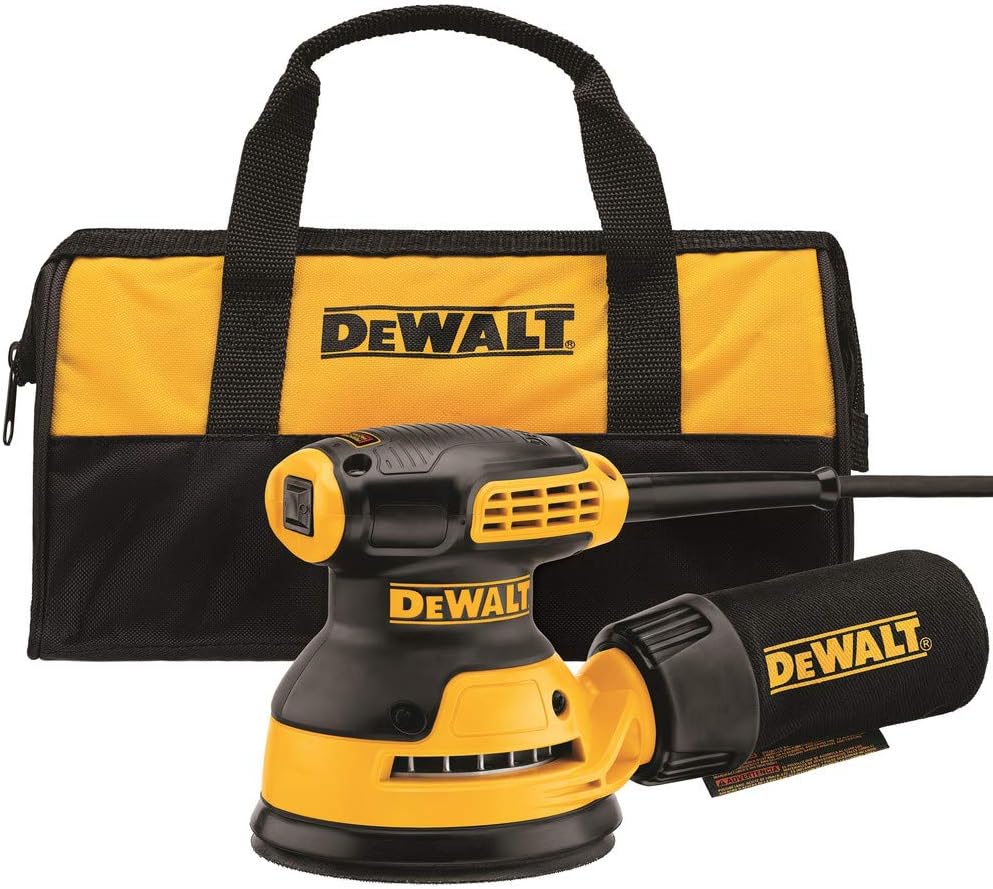
3. Best for durability and warranty: DEWALT DWE6421K Orbital Sander Kit
The DEWALT DWE6421K is a 5-inch corded sander with a 3.0 amp motor that delivers 12,000 OPM. It features a separate counterweight design and rubber over-mold in critical areas to reduce vibration and improve user comfort. The sander has a shorter height, which the listing states allows the user to get closer to the workpiece.
It includes an improved dust-sealed switch for longer life and a one-handed locking dust bag for collection. The kit comes with a dust bag and a carrying bag. A significant advantage is the manufacturer’s three-year limited warranty.
Best for: Users who prioritize a long tool warranty and a robust, vibration-dampened design for frequent use.
Pros
- 3.0 amp motor for solid power
- Three-year limited warranty
- Rubber over-mold and counterweight reduce vibration
- Includes a carrying bag
Cons
- The listing does not mention included sanding discs
- Dust collection uses a bag, not a canister
4. Best for heavy-duty stock removal: BOSCH GET75-6N Electric Sander/Polisher
The Bosch GET75-6N is a larger, more powerful 6-inch sander and polisher with a 7.5 amp motor. It offers dual sanding modes: a standard random orbit mode for finishing and a “Turbo” driven eccentric orbit mode for aggressive stock removal. The listing states the Turbo mode removes material at five times the rate of the standard mode.
It has a variable speed motor with an orbital speed range of 3,300 to 7,300 OPM. Dust collection is passive and requires connection to a vacuum cleaner (hose adapter included). The kit includes a soft backing pad, sanding disc, hex wrench, removable front handle, and two vacuum hose adapters.
Best for: Large projects like wood floors or furniture refinishing that require fast, aggressive material removal.
Pros
- Powerful 7.5 amp motor
- Turbo mode for aggressive stock removal
- Dual-mode operation (sander and polisher)
- Includes a removable front handle for control
Cons
- Large and heavier than palm sanders
- Requires a separate vacuum for dust collection
- The listing does not mention a warranty
5. Best kit with accessories: HYCHIKA 5-Inch Random Orbital Sander
The HYCHIKA sander is powered by a 300W motor (listed as 2.5 A) and offers six variable speeds up to 13,000 RPM. It comes with a comprehensive kit that includes 12 sanding discs in three grits (80, 120, and 240). Dust collection uses an upgraded large-capacity dust bag connected to eight vacuum holes.
The tool features an ergonomic, textured rubber grip designed to reduce fatigue and a hook-and-loop system for changing discs. The listing mentions professional customer service and support for the product’s lifecycle.
Best for: Beginners who want a complete starter kit with a wide assortment of sandpaper.
Pros
- Comes with 12 sanding discs in multiple grits
- Six variable speed settings
- Textured rubber grip for control
- Large-capacity dust bag
Cons
- The listing does not mention a manufacturer’s warranty
- Brand is less established than others in the category
Our picks at a glance
| Model | Disc Size | Motor (Amps) | Key Feature | Included Components |
|---|---|---|---|---|
| SKIL SR211601 | 5 in (128 mm) | 2.8 A | Cyclonic dust box | Sander, dust box, 3 sanding sheets |
| BOSCH ROS20VSC | 5 in | 2.5 A | Swirl-free pad dampening | Sanding pad, disc, canister, adapter, bag |
| DEWALT DWE6421K | 5 in | 3.0 A | 3-year warranty | Sander, dust bag, carrying bag |
| BOSCH GET75-6N | 6 in | 7.5 A | Turbo stock-removal mode | Backing pad, disc, handle, adapters |
| HYCHIKA | 5 in | 2.5 A | 12 sanding discs included | Sander, 12 discs, dust bag |
How to choose a random orbital sander
The right sander makes surface preparation faster and leaves a better finish. Your choice depends on the scale of your projects, the materials you work with, and your workspace. For most indoor DIY jobs, a 5-inch model strikes a good balance between power and maneuverability.
Dust collection is critical for a clean workspace and your health, especially when sanding old paint that may contain lead. Always follow safety guidelines from the EPA and wear appropriate respiratory protection. Systems range from simple bags to cyclonic canisters or connections for a shop vacuum. A good dust system also keeps the sanding surface clean for a smoother result.
What to look for
- Power and Speed: Motor amperage and orbits per minute (OPM) indicate performance. Variable speed control lets you match the sander to the material.
- Dust Management: Look for effective collection systems. Canisters are easy to empty, while vacuum hookups offer the cleanest operation.
- Ergonomics and Vibration: Features like rubber grips, counterweights, and a balanced design reduce fatigue, allowing for longer, more comfortable use.
- Disc Attachment: A hook-and-loop (Velcro-style) pad is the standard for quick, tool-free sandpaper changes.
- Kit Contents: Check what’s included. Some sanders come with a variety of sanding discs, a carrying case, or dust collection accessories, offering better immediate value.
Finally, consider the warranty as an indicator of the manufacturer’s confidence in the tool’s durability. For more information on using these tools safely and effectively, explore our other guides in the Power Tools category.
FAQ
What is the difference between an orbital sander and a random orbital sander?
A standard orbital or “palm” sander moves in small, consistent circles, which can sometimes leave visible swirl marks on the finished surface. A random orbital sander combines this orbiting motion with a simultaneous spin, creating a random pattern that typically eliminates swirls and results in a smoother finish, making it a more versatile choice for fine woodworking and finishing.
Can I use my random orbital sander for polishing?
Yes, many random orbital sanders can be used for polishing when equipped with a soft buffing pad and the appropriate polish or wax. Some models, like the Bosch GET75-6N listed above, are explicitly marketed as sander/polishers. Always ensure the sander has a variable speed control, as polishing requires lower speeds than aggressive sanding. Follow the manufacturer’s instructions for attachments and recommended speeds.
How important is dust collection?
Extremely important. Effective dust collection keeps your work area cleaner, improves visibility, and most importantly, protects your health. Inhaling fine dust from wood, drywall, or old paint can be harmful. Always use the sander’s dust collection system, whether it’s a bag, canister, or vacuum hookup. For extensive work, especially in enclosed spaces, also use a respirator approved for fine particles. Learn more about respiratory protection from OSHA.
What grit sandpaper should I start with?
The starting grit depends on the condition of your material. For rough wood with deep scratches or old paint removal, begin with a coarse grit (like 80). For smoothing surfaces between coats of paint or finish, use a fine grit (like 220). Always progress through grits sequentially (e.g., 80, 120, 180, 220) for the best results, sanding just until the scratches from the previous grit are removed. Our buying guide covers this in more detail.
References
- Amazon product listings and manufacturer specifications (accessed October 2026)
- U.S. Environmental Protection Agency (EPA). Renovation, Repair and Painting Program. https://www.epa.gov/lead/renovation-repair-and-painting-program
- Occupational Safety and Health Administration (OSHA). Respiratory Protection. https://www.osha.gov/respiratory-protection

About Emily Jennings
Emily has been writing about diy home renovation for this site, with an eye on clear explanations, honest trade-offs and options for different needs and budgets.